The Seven Mayfair Restaurants You Need To Be Seen At
You can eat very well in Mayfair without learning anything. There is a whole category of restaurant here that exists to be photographed: enormous, expensive, gold, forgettable.
This is not that list. These seven are places where something actually happened. A restaurant sold over a plate of oysters during an air raid. A dining room named after a courtesan who was painted by Reynolds and pursued by Casanova. A townhouse that housed the suffrage movement and then Christian Dior. The table where Ian Fleming worked out what his spy would order.
They are arranged roughly by age, which turns the list into a walk through three hundred years of Mayfair behaving badly. Book all of them well in advance.
Wiltons, 55 Jermyn Street
In 1742 George William Wilton started selling oysters from a barrow near Haymarket. By 1868 the business held a Royal Warrant as oyster purveyor to Queen Victoria. It is, by most reckonings, the second oldest restaurant in London.
But the story people tell is from 1942. A bomb fell on nearby St James's Church, shaking the building. The owner, Bessie Leal, decided on the spot that she was finished with wartime London. She took off her apron, folded it, and asked a regular who was sitting at the marble bar eating oysters whether he knew of anyone who might want to buy a restaurant.
The regular was Olaf Hambro, chairman of Hambros Bank. He replied that he did not know of anybody other than himself, and told her to put the restaurant at the end of his bill. She did. The next morning she left for Cornwall and never came back. The Hambro family still owns Wiltons.
What to order: Oysters, obviously, and the Dover sole. The twice-baked Stilton soufflé has its own devoted following.
Know before you go: Closed Sundays, and Saturday evenings only. Book weeks ahead. Smart dress.
What it says about you: You would have bought the restaurant too.
Kitty Fisher's, 10 Shepherd Market
Shepherd Market was built in the eighteenth century on the site of the fifteen-day May fair that gave the whole district its name, and it spent most of the next two centuries as Mayfair's least respectable corner. Kitty Fisher lived nearby on Carrington Street. She was a courtesan, and she was famous in the way modern celebrities are famous: painted repeatedly by Sir Joshua Reynolds, written about constantly in the Grub Street press, sought out by Casanova when he came to London. She managed her own image with total command and died young.
She also survives in a nursery rhyme most British children can still recite without any idea who she was. Lucy Locket lost her pocket; Kitty Fisher found it.
The restaurant is a small Georgian townhouse with a wood grill, red banquettes and twenty-seven covers. It has been booked out more or less continuously since it opened in 2015.
What to order: Whatever is on the grill, and the crispy potatoes, which have their own reputation.
Know before you go: Closed Sundays. Tiny. Book a long way ahead.
What it says about you: You know exactly whose name is above the door, and you approve.
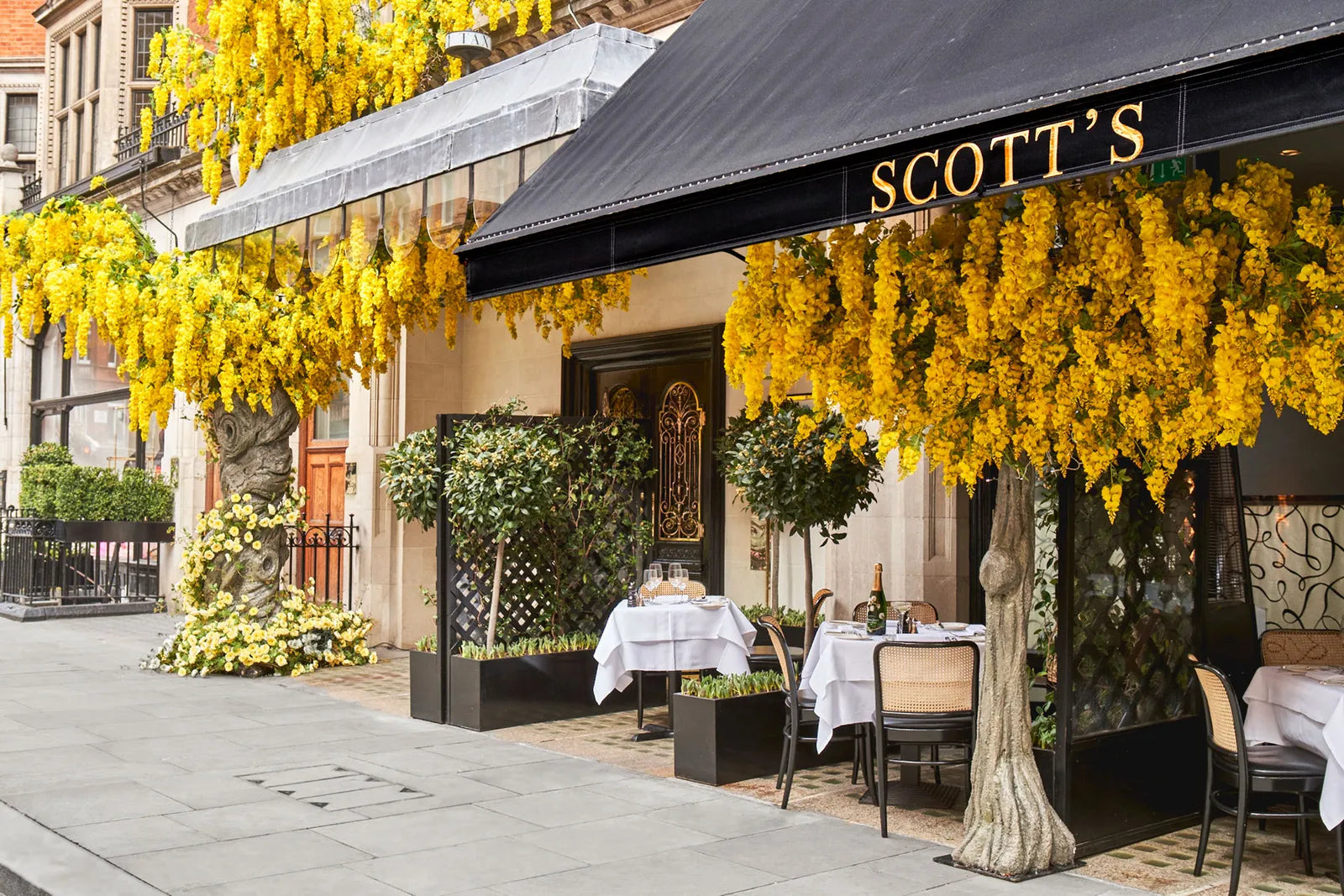
Scott's, 20 Mount Street
Founded in 1851 by a young fishmonger called John Scott as an oyster warehouse, and located on Coventry Street for over a century before moving to Mount Street in 1967.
Ian Fleming lunched here for years, including during the war while he was at Naval Intelligence. On one occasion he brought two captured German U-boat officers to Scott's with the intention of getting them drunk enough to explain how they had slipped past British mines in the Skagerrak. The plan collapsed when the head waiter overheard the table speaking fluent German and quietly rang Scotland Yard. Special Branch arrived. Fleming's colleagues found this hilarious. His superior officer did not.
Fleming kept a regular table, a corner two-top on the first floor, and later gave the same table to Bond. Scott's also claims the origin of "shaken, not stirred," a claim Dukes Bar makes too. Both are probably telling the truth as they understand it, which is how legends work.
What to order: Oysters at the bar. Then the fish of the day, plainly done.
Know before you go: Open daily. The outside tables on Mount Street are the ones people fight for.
What it says about you: You take your fiction seriously enough to go and eat in it.
The Ritz Restaurant, 150 Piccadilly
The most beautiful dining room in London, and it is not a close contest. César Ritz opened the hotel in 1906 with Auguste Escoffier, the man who invented the modern professional kitchen, running the food. The room is Louis XVI, gilded, garlanded, with trompe l'oeil sky and a view over Green Park.
The Ritz was where young unmarried women were first allowed to arrive without a chaperone, which is a genuinely radical footnote for 1906. It is also the only hotel in the world to hold a Royal Warrant. Churchill, Eisenhower and de Gaulle planned operations upstairs in the Marie Antoinette Suite. Jackie Onassis called the place paradise.
On Fridays and Saturdays there is a band and a dance floor, which almost no London restaurant offers any more and which changes an evening completely.
What to order: Whatever is carved at the table. This is a room for the full performance.
Know before you go: Jacket and tie required for gentlemen, and the dress code is enforced. Book the dine-and-dance nights well ahead.
What it says about you: You dress for dinner. You always have.
The Wolseley, 160 Piccadilly
The building went up in the 1920s as a car showroom for Wolseley Motors, which is why the dining room has the proportions and the sweeping staircases of a place designed to display something expensive and shiny. Wolseley went under, and Barclays moved in and ran it as a bank for decades. Corbin and King took the site in 2003 and turned it into a European grand café, which is what the room had clearly been waiting to become.
It is not the oldest restaurant on this list but it may be the most useful. It opens at seven in the morning and serves properly until late. Breakfast at the Wolseley is an institution in its own right, and it is the rare Mayfair room where you can arrive alone with a newspaper and feel entirely correct.
What to order: Breakfast. The kippers, the eggs Benedict, or the viennoiserie. Afternoon tea if you want the fuller version.
Know before you go: Open every day from early. Walk-ins are sometimes possible, which is unusual around here.
What it says about you: You understand that the best meal of the day is often the first one.
Langan's Brasserie, Stratton Street
In 1975 Michael Caine walked into a restaurant called Odin's, ate the crème brûlée, and proposed to the chef that they open the most fabulous restaurant in London. The chef was Peter Langan. Caine would bring the guest list; Langan would bring the atmosphere. Richard Shepherd joined the following year to actually cook. It opened in October 1976 on the old Coq d'Or site with no dress code, mismatched lamps and walls covered in art that Langan had swapped for meals with the painters who ate there. David Hockney designed the menu, and a copy of it now sits in the National Portrait Gallery.
For about a decade it was the centre of the world. Elizabeth Taylor, Marlon Brando, Princess Margaret, Mick Jagger, Muhammad Ali, Francis Bacon, Jack Nicholson. Joan Collins said that anybody who was anybody lunched or dined there.
Langan himself was the show and eventually the tragedy. He insulted Orson Welles's weight to his face, threw people out for being dull, once put out a kitchen fire with champagne, and drank himself to death at forty-seven. The restaurant went into administration in 2020 and was revived in 2021 by people who understood what they had bought.
What to order: The spinach soufflé with anchovy sauce, which never left the menu. Then the beef Wellington.
Know before you go: Open daily, late at the end of the week. There is a bar upstairs with live music.
What it says about you: You would rather be at the interesting table than the quiet one.
Sketch, 9 Conduit Street
The newest restaurant here and the oldest room, which is the joke of the place. The townhouse was built in 1779 by James Wyatt, the architect, as a private residence. From 1885 it housed the Royal Institute of British Architects. In the early twentieth century the suffrage movement worked out of the building. After the war it became the London atelier of Christian Dior, fitted out by Victor Grandpierre in dove grey drapes with a cascading staircase, and it stayed in Dior's hands until the nineties.
So: architects, suffragettes, couture, and now a restaurant. Not many addresses in London have had a better run.
Mourad Mazouz and Pierre Gagnaire opened Sketch here in 2002 as five separate rooms with five separate personalities. The Lecture Room and Library holds three Michelin stars. The Gallery was famously pink from 2014, wrapped around David Shrigley drawings by the designer India Mahdavi, and was reworked by Mahdavi again in 2022 with textile works by Yinka Shonibare. The lavatories are egg-shaped pods and are probably the most photographed toilets in Europe.
What to order: Afternoon tea in the Gallery if you want the room. The Lecture Room and Library if you want the cooking, which is extraordinary and priced accordingly.
Know before you go: Book far ahead for the Lecture Room. The dress code is listed as art smart, which means roughly what you would hope.
What it says about you: You would have been in this building in any century.
The real rule
Look at what these places have in common. A woman who sold her restaurant mid-air-raid rather than spend another night in London. A courtesan who turned her own notoriety into a career and then into a nursery rhyme. A spy novelist smuggling prisoners of war into lunch. An Irish chef who insulted Orson Welles.
Not one of them was being sensible. They were being entirely themselves in a very good room, and the rooms are still standing because of it.
Book the table. Order the thing you actually want. Stay for another glass.
And dress like you mean it. Rosenworth's Bordeaux Dress was made for exactly this sort of evening, and the Blenheim Robe for the part afterwards that nobody writes about.