The Eight Mayfair Bars You Need to Know
Mayfair has more bars than anyone needs and about eight that matter. The difference that makes or breaks a bar in Mayfair is whether the room has a story worth sitting inside.
These are rooms where exiled kings sat out the war, where Kipling wrote, where Ian Fleming worked out what his spy should drink, and where an actress once drank champagne out of her own shoe in front of the press and got away with it. All of them will make you a proper drink. None of them will rush you, which is the actual luxury.
A note before you go: several are walk-ins only, several are closed on Sundays, and at least two will have a queue by seven. Plan accordingly, or go at five like a professional.
Dukes Bar, 35 St James's Place
Start here, because everything else is downstream of it. Dukes opened in 1908 down a cobbled cul-de-sac so well hidden that people still describe finding it rather than going to it. From the 1950s the bar was staffed by Italians, and it was in this period that Ian Fleming became a regular.
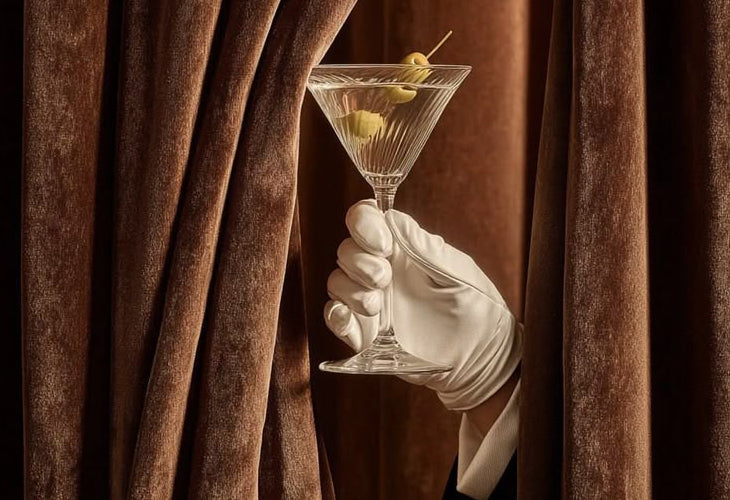
The legend, which Dukes is happy to tell you and which nobody has ever seriously bothered to disprove, is that it was here, arguing with the barmen about the correct construction of a martini, that Fleming arrived at "shaken, not stirred." Bond's first drink order in Casino Royale broke every rule of the day. Martinis were stirred, never shaken. You did not combine two white spirits. You certainly did not name a cocktail after a woman. Fleming had Bond do all three at once, and the Vesper was born.
Dukes still makes them on a trolley wheeled to your table, spirits straight from the freezer, no ice in the glass. There is a house limit of two, which sounds like an affectation until you have had one.
What to order: The Vesper, or the Fleming 89. Both are on the menu for the obvious reason.
Know before you go: Two-drink maximum, and they mean it. Smart dress. Small room, so go early.
What it says about you: You went to the source.
The Connaught Bar, 16 Carlos Place
The hotel opened in 1897 as The Coburg, named for Victoria's German consort, and was hastily rebranded The Connaught in 1917 when German names stopped being fashionable in London. That is the sort of history this building has: quiet, grand and slightly embarrassed about the middle of the twentieth century.
The bar itself is more recent, opened in 2008 to a David Collins design that does 1920s Cubism in silver leaf and low light. It has twice been ranked the best bar in the world and is still in the top ten. Ralph Lauren admired the hotel's staircase so much he had a copy built into his Madison Avenue flagship.
The reason to come is the martini trolley. Your spirit, your vermouth, your bitters, built at your table over several minutes. Let it take as long as it takes.
What to order: The Dry Martini. If gin is not your thing, the seasonal list is genuinely inventive.
Know before you go: Walk-ins only. Closed Sundays. Arrive at four when it opens or expect to stand.
What it says about you: You start at the top. You have nothing to prove afterwards.
The Painter's Room, Claridge's, Brook Street
No hotel in London has a better guest list. During the war Claridge's housed so many displaced monarchs that when a diplomat rang in 1947 asking to speak to the King, the operator reportedly replied, "Certainly sir, but which one?" The Kings of Greece, Norway and Yugoslavia were all in residence, along with the Queen of the Netherlands.
In July 1945 Churchill had Suite 212 declared Yugoslav territory for a day so that Crown Prince Alexander could be born on his own country's soil. Legend has it a clod of Yugoslav earth was placed under the bed.
Then Hollywood arrived. Cary Grant, Audrey Hepburn, Bing Crosby, Yul Brynner. Spencer Tracy said that when he died he would rather go to Claridge's than heaven. And when Katharine Hepburn turned up in trousers and was told the dress code required a skirt, she declined to change, and came in through the staff entrance instead.
The Painter's Room is the small jewel box of a bar upstairs from all that history: onyx, pale marble, and a fraction of the seats of the main bar. The drinks lean bitter and aperitivo, built for before dinner rather than instead of it.
What to order: Whatever the aperitif of the moment is. I once turned up with a sore throat and asked for anything with honey, I was duly rewarded and soothed
Know before you go: Tuesday to Saturday, from 4.30pm. Genuinely tiny, so book.
What it says about you: You know the famous bar and the best bar in a building are rarely the same room.
The Donovan Bar, Brown's Hotel, 33 Albemarle Street
Brown's opened in 1837, founded by James Brown, formerly Lord Byron's butler, and his wife Sarah, formerly Lady Byron's maid. It is London's oldest hotel and the guest list is faintly ridiculous. Alexander Graham Bell made Britain's first telephone call from here in 1876. Rudyard Kipling honeymooned here and came back for decades, finishing work on The Jungle Book in the process. Agatha Christie based At Bertram's Hotel on it. Stephen King sat at Kipling's desk, drank a great deal of tea, and outlined Misery. Theodore Roosevelt stayed for a fortnight before his wedding, listing his profession on arrival as "rancher."
The bar is named for the photographer Terence Donovan, a friend of the Forte family, whose black and white prints cover the walls. The drinks are overseen by Salvatore Calabrese, who invented the Breakfast Martini and holds a Guinness World Record for the most expensive cocktail ever made, and who pours from a personal collection of pre-twentieth-century spirits.
Ask for the Naughty Corner, a semi-private alcove under Donovan's boldest portraits, seating twelve.
What to order: A Breakfast Martini, from the man who invented it. Or ask to see the vintage list, even if you have no intention of ordering from it.
Know before you go: Open every day, which makes it the Sunday answer when the Connaught is shut.
What it says about you: You came for the drink and stayed for the conversation.
The Rivoli Bar, The Ritz, 150 Piccadilly
Technically St James's, which nobody has ever cared about while walking down Piccadilly. César Ritz opened the hotel in 1906 and it was fashionable immediately. It was the first hotel in London where young unmarried women were permitted to arrive without a chaperone, a fact worth pausing on.
The stories are extraordinary. Anna Pavlova danced here. Chaplin needed forty policemen to get him through the crowd in 1921. Churchill, Eisenhower and de Gaulle met in the Marie Antoinette Suite during the war. Noel Coward wrote songs on the premises, including one actually called "Children of the Ritz." And in 1951 Tallulah Bankhead held a press conference in the bar and drank champagne out of her slipper, which remains the single most Rosenworth thing any woman has ever done in a Mayfair hotel.
The original Rivoli ran the length of the Piccadilly frontage until 1972, when it was carved up into shops. It was recreated in 2001 by Tessa Kennedy in gold, walnut and camphor wood, modelled on a carriage of the Orient Express.
What to order: A champagne cocktail, in Tallulah's memory. Slipper optional.
Know before you go: Open daily from 11.30am. Standards of dress are high. Check the current code before you leave the house.
What it says about you: You still believe in occasions.
Le Magritte, The Beaumont, 8 Balderton Street
The youngest room on this list and the quietest, tucked into Brown Hart Gardens, a square most people walk straight past. The Beaumont occupies a 1926 building done as full Art Deco, with an Antony Gormley sculpture grafted onto the side of it, and Le Magritte is the small dark bar off the lobby: surrealist art, soft jazz, roughly the dimensions of a generous sitting room.
It has no exiled monarchs and no dead novelists. What it has is a door that opens at eight in the morning, which is a useful thing to know about a bar. Oysters and a glass of something at lunch here is one of the more civilised hours available in W1.
What to order: Champagne and oysters if it is early. A martini if it is late.
Know before you go: Small. If the bar is full, the lobby seating outside it is nearly as good.
What it says about you: You found the quiet one.
Mr Fogg's Residence, 15 Bruton Lane
The conceit is that this is the London home of Phileas Fogg, the gentleman who circumnavigated the globe in eighty days for a wager of twenty thousand pounds in Jules Verne's 1873 novel. You ring a doorbell in an alley and are let into a Victorian explorer's drawing room crammed to the ceiling with taxidermy, penny-farthings, maps and hot air balloon paraphernalia.
It is unashamedly theatrical and completely committed, which is why it works where a half-hearted version would be unbearable. Verne's Fogg was a man of absolute routine who bet his entire fortune on a timetable. The bar has taken that energy and run with it.
What to order: Something from the elaborate end of the menu. Ordering a gin and tonic here wastes everyone's afternoon.
Know before you go: Closed Sundays and Mondays. Booking is sensible. Saturdays it opens at three, a rare Mayfair option for daytime drinking.
What it says about you: You are not too sophisticated to enjoy yourself. This is a compliment.
Kwãnt, 52 Stratton Street
The modern entry, and the corrective to any suggestion that Mayfair drinking is all heritage and hotel carpets. Kwãnt is a basement bar doing technically ambitious things, with infusions, clarifications and an omakase cocktail pairing if you want the full performance, in a room that stays lively rather than reverent.
No royalty has ever been exiled here. What it has instead is the bartenders from the other seven on this list, who come here on their nights off. That is the only recommendation that really counts.
What to order: Ask what they are excited about. If you want structure, book the omakase.
Know before you go: Open seven days from 5pm. Reserve for the omakase; walk in for the bar.
What it says about you: Your taste is current, not just inherited.
The real rule
Every one of these rooms was made glamorous by someone behaving exactly as they pleased in it. Hepburn kept her trousers on. Bankhead drank out of her shoe. Fleming argued with the barman until he got the drink he wanted and then gave it to the most famous character in twentieth-century fiction.
None of them were being well behaved. They were being themselves, at volume, in a very good room. That is the whole tradition, and it is available to anyone who walks in and orders what she actually wants.
And dress for it. Rosenworth's Bordeaux Dress was made for exactly this, and the Blenheim Robe for the hour afterwards, when you are home, glorious, and not remotely ready for the evening to be over.